Tri-Agency CV Guide
Creating a definitive resource for narrative CV drafting
(and a really cool AI tool, too)
1. My Vision: Bridging Policy and Practice
The transition from traditional, list-based academic CVs to the Tri-Agency Narrative CV (TCV) represents one of the most significant cultural shifts in the Canadian research landscape. As a signatory of the San Francisco Declaration on Research Assessment (DORA), the Tri-Agencies required a tool that didn’t just list outputs, but told a story of impact.
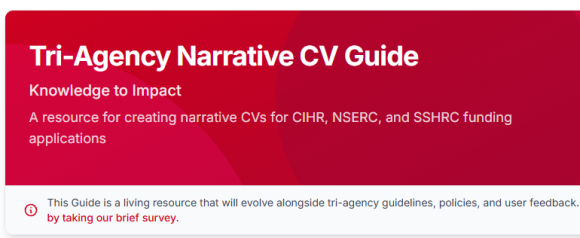
I led the end-to-end creation of the TCV Guide, transforming complex, evolving federal policies into a streamlined, user-friendly digital platform. This wasn’t just about formatting; it was about helping researchers translate a lifetime of achievement into a narrative that reviewers can value.
2. My Expertise: Deep Consultation & Synthesis
The Guide’s content is grounded in over a year of deep engagement. I synthesized insights from:
National Consultations: Collaborative feedback from partners across Canadian universities and colleges.
Direct Engagement: Learnings from leading national webinars, in-person workshops, and hours of 1:1 consulting with researchers at the University of Calgary.
Policy Analysis: Distilling the nuances of DORA and Tri-Agency requirements into a “4-Step Method” (List, Define, Describe, Support) that makes the daunting task of narrative writing achievable for anyone.
Users-First Approach: The Guide highlights my user-centric design philosophy and writing-style. It is meant to be accessible, informative, and approachable to as many individuals as it can. I want to “meet them where they are”, while guiding them along a new path that they may not be entirely confident exploring.
3. My Build: Architecture & Technical Execution
To ensure maximum accessibility and performance, I moved beyond static PDFs to build a custom React-based web application.
Architecture: Developed a lightweight, responsive single-file architecture using React, Tailwind CSS, and Lucide-React.
UX/UI Design: Created a fluid, navigation system that allows researchers to move seamlessly between guidance, examples, and the interactive “Quick Start” checklist.
Full Stack Web Development: Integrated GitHub repos, linked to CloudFlare Pages, deployed to a custom domain. I rigged up the whole system!
- Full RAG (Retrieval Augmented Generation) stack running on CloudFlare – using KV and AI Workers, I was able to provide my chatbot with persistent global context (the entire TCV Guide), so its answers are accurate and directly informed by our OWN resource, not only prior baseline training on a stateless Claude model. (In simpler terms; my chatbot is not simply a different place to use Claude’s – it is directly informed by the TCV Guide itself as a primary source of truth and information!)
4. My Innovation: Ethical AI Integration
The cornerstone of the Guide is the integrated AI Chatbot Assistant. Recognizing the “blank page syndrome” and the ethical concerns surrounding GenAI in grant development, I built a custom solution that prioritizes security and researcher agency.
Custom AI Logic: Integrated the OpenRouter API to leverage high-reasoning models (Claude 4.5 Sonnet). I engineered the system prompt to act as an “editorial partner” rather than a content generator—focusing on gap analysis, evidence identification, and DORA compliance.
Security & Privacy: Developed a client-side-only storage model. User inputs and uploaded files are used as context for the session and are never stored on a server, addressing the #1 concern for academic data security. (I have a hybrid global context RAG system for the TCV Guide as persistent context, coupled with a prompt injection method for additional context from user uploaded documents that are parsed by the user’s browser directly!)
Tailored Support: The assistant helps researchers identify “qualitative evidence” (e.g., testimonials, policy mentions) to replace “surrogate metrics” like Journal Impact Factor and h-index, aligning perfectly with modern responsible research assessment standards.
5. My Impact
The TCV Guide stands as a definitive resource in the Canadian research community. It represents the successful synthesis of cutting-edge technology and high-level policy expertise, ultimately empowering researchers to navigate institutional change with confidence and articulate their impact with precision.
View the Live Project: tcvguide.ca
Technologies Used: React, JavaScript, Tailwind CSS, OpenRouter/LLM Integration/dynamic AI prompting and context management, CloudFlare Workers/KV/Vectorization